




In recent years, research peptides have attracted considerable attention in the scientific community. Among the many compounds studied in laboratory environments, BPC-157 and TB-500 stand out for their unique structures and the intriguing effects they exhibit in experimental research. When combined into a single blend, they present an opportunity for researchers to explore potential synergies that may not be as apparent when the peptides are studied individually.
The BPC-157 / TB-500 blend has therefore become a valuable research tool that allows laboratories to investigate new frontiers in peptide science.
Understanding BPC-157
BPC-157 is a peptide fragment that originates from a larger protein found in the stomach. It is composed of 15 amino acids, giving it a relatively small molecular structure that makes it of particular interest for laboratory analysis. Researchers value BPC-157 for its stability under various conditions and its resilience compared to other short peptides.
Studies on BPC-157 within research settings have often focused on its interactions with cellular pathways, its influence on angiogenesis, and its potential impact on tissue repair processes. These areas of investigation make it an appealing peptide for scientists who want to explore how peptide signaling can affect cell communication and structural responses in controlled environments.
Understanding TB-500
TB-500, on the other hand, is a synthetic version of a naturally occurring peptide sequence found within a larger protein called thymosin beta-4. The sequence studied in TB-500 contains 43 amino acids and is frequently associated with cellular migration and actin regulation.
Researchers examining TB-500 in laboratory conditions often highlight its role in cell differentiation, migration, and remodeling processes. In scientific studies, TB-500 is frequently linked to angiogenesis as well, giving it a thematic overlap with BPC-157 and making the pair a logical blend for further investigation.
Why Combine BPC-157 and TB-500?
Both peptides have overlapping areas of interest in laboratory research, particularly in studies related to angiogenesis and cellular migration. Individually, they provide unique insights into different biochemical pathways, but when combined, they allow researchers to examine how multiple peptide signals may interact within the same experimental framework.
The concept of peptide synergy is central to the appeal of the BPC-157 / TB-500 blend. By working in tandem, the peptides offer laboratories the opportunity to investigate whether their combined presence enhances or modifies the effects typically observed in single-peptide studies. This blending approach aligns with the broader scientific practice of combining compounds to better understand their complementary or contrasting mechanisms.
Exploring the Science of Synergy
When studied in isolation, BPC-157 and TB-500 have shown intriguing interactions with processes tied to angiogenesis and cellular signaling. In research settings, BPC-157 is often evaluated for its stability and effect on growth pathways, while TB-500 is studied for its regulation of actin and its involvement in cellular migration.
When researchers introduce the two peptides together, they are able to design experiments that explore overlapping biological processes. For example, experiments may be conducted to measure the degree to which the peptides influence blood vessel formation when introduced simultaneously compared to individually. Similarly, their combined effects on tissue cultures can be compared with single-peptide studies to highlight any significant differences.
This potential makes the BPC-157 / TB-500 blend an attractive subject for ongoing research, since it broadens the scope of scientific inquiry and provides more complex data sets for analysis.
Applications in Laboratory Research
It is important to emphasize that the BPC-157 / TB-500 blend is used strictly for research purposes and is not intended for human consumption. Laboratories and academic researchers studying these peptides typically use them in controlled experiments designed to better understand peptide interactions and mechanisms.
Potential areas of research include:
- Angiogenesis Studies: Exploring how the blend influences blood vessel formation in tissue models.
- Cell Migration Experiments: Measuring the effects on cell movement in laboratory assays.
- Signal Pathway Research: Mapping out the biochemical cascades activated by the peptides.
- Comparative Analysis: Contrasting results from blended peptide studies with those from individual peptide testing.
By using the blend in these ways, researchers can generate data that contributes to the growing body of peptide knowledge.
The Future of Peptide Research
The BPC-157 / TB-500 blend highlights an important trend in peptide science: the movement toward studying combinations rather than isolated compounds. Just as many biological processes involve multiple signals working together, combining peptides in controlled laboratory conditions allows for more realistic models of complex biochemical environments.
As peptide science continues to advance, blends like BPC-157 / TB-500 will likely remain at the forefront of research efforts. Their unique synergy provides opportunities for deeper insights into molecular interactions, making them a powerful tool for the scientific community.
The science behind the BPC-157 / TB-500 blend demonstrates why it has become such a valued resource in laboratory research. Individually, both peptides offer intriguing insights into cellular signaling, angiogenesis, and migration. Together, they form a blend that allows researchers to study synergistic effects and uncover patterns that may not emerge from single-peptide investigations.
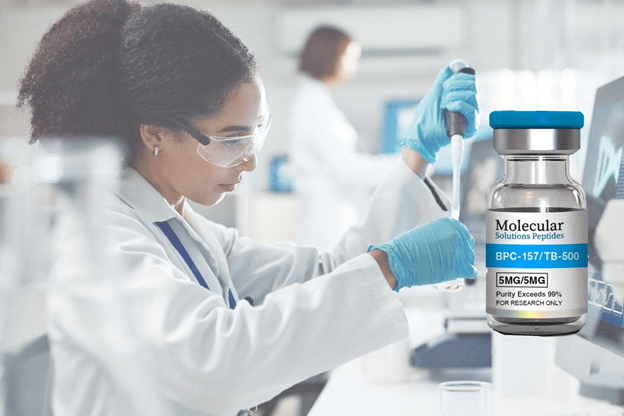
For laboratories seeking high-quality peptide blends for research purposes, Molecular Solutions Peptides provides reliable and rigorously tested products. Our dedication to purity and consistency makes them a trusted source for researchers who want to explore the potential of compounds like the BPC-157 / TB-500 blend.
Disclaimer: All products on this site are for Research, Development use only. Products are Not for Human use of any kind. The statements made within this website have not been evaluated by the US Food and Drug Administration. The statements and the products of this company are not intended to diagnose, treat, cure or prevent any disease.
