
TB-500
At Molecular Solutions Peptides, our entire operation is built around delivering precise, reproducible research materials. We operate exclusively with small-batch production, allowing us to carefully manage quality from synthesis through shipment. Every lot of our TB-500 undergoes rigorous third-party testing for purity, quantification, identity, and sterility, with our internal targets set at 99.5% or higher purity. All results are always disclosed batch by batch for true transparency. Beyond TB-500 peptide products, we also formulate specialty options like our Glow Peptide Blend, backed by the same testing rigor. By offering same-day domestic fulfillment and responsive, knowledgeable customer service, we ensure our research-use-only (RUO) peptides meet the demanding standards required for serious scientific work in the United States.

TB-500/Thymosin Beta-4 (10mg) (43aa & Frag 17-23)
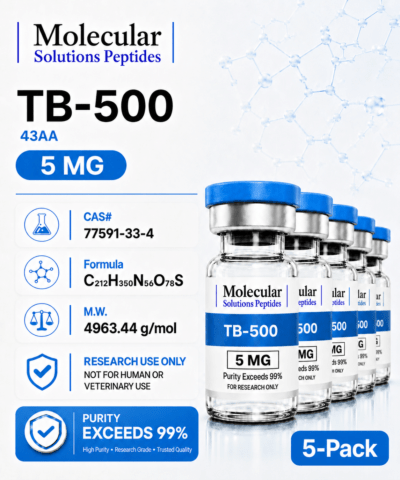
TB-500(Thymosin Beta-4) 5mg (43aa) 5-Pack

GLOW Peptide Blend – 70mg (GHK-Cu 50mg / TB-500 10mg / BPC-157 10mg)

Check out our Blog

What Is TB-500 (Thymosin Beta-4 Fragment) in Research Contexts?
TB-500 is a synthetic peptide associated with a sequence of thymosin beta-4 and is supplied by Molecular Solutions Peptides strictly for laboratory research use.
In preclinical research, compounds associated with thymosin beta-4 have been examined for interactions with actin and for cellular processes such as migration and responses within controlled experimental environments. These investigations are conducted to better characterize molecular and cellular behavior under defined research conditions.
Current TB-500 research remains primarily preclinical, and findings should be interpreted within the specific experimental models in which they were observed.
Molecular Solutions Peptides supplies TB-500 for scientific research only. Product specifications and available analytical documentation are provided to support laboratory identification, quality review, and reproducibility.
Common Misconceptions About TB-500 in Online Sources
Information about TB-500 online can vary considerably in quality and context. Research findings should be evaluated using the original scientific literature and within the limitations of the experimental models involved.
Misreading Preliminary Studies
Early-stage findings are sometimes presented online without sufficient context. An individual study represents evidence from a specific experimental design and should not automatically be treated as a broadly established conclusion.
Researchers should review the original publication, methodology, experimental model, measured endpoints, and limitations when evaluating claims related to TB-500.
Assuming Research Results Are Universally Applicable
Findings from one experimental model should not automatically be generalized to other organisms, systems, or research environments.
Results may vary depending on the model, experimental conditions, methodology, and endpoints being investigated. Interpretation should remain limited to what the available evidence supports.
Confusing TB-500 With Similar Peptides
TB-500 may be discussed alongside other research peptides, including BPC-157, but these compounds have distinct molecular characteristics and research profiles.
They should not be considered interchangeable solely because they appear together in online discussions or research-product comparisons. Each compound should be evaluated according to its own published literature and analytical characteristics.
Limitations of Current TB-500 Research
Current scientific literature on TB-500 and related thymosin beta-4 sequences contains important limitations that should be considered when reviewing available findings.
Reliance on Preclinical Models
Much of the available research involves in vitro systems or animal models.
These studies can provide useful information about molecular and cellular activity under controlled experimental conditions, but findings from these models cannot automatically be generalized beyond the systems studied.
Variation Across Investigations
Research findings may differ depending on experimental design, model selection, timing, analytical methods, and measured endpoints.
Differences between studies reinforce the importance of reviewing the methodology and limitations of each investigation rather than treating individual findings as universally applicable.
Limited Long-Term Data
Available research does not provide complete information regarding long-term biological effects across all experimental systems.
Additional controlled research is required to further characterize TB-500 and related thymosin beta-4 sequences across different laboratory models and experimental conditions.
The Bottom Line on TB-500 Research
TB-500 remains an area of ongoing preclinical research.
Published studies have investigated molecular and cellular processes associated with thymosin beta-4-related sequences, but the available evidence remains dependent on specific laboratory models and experimental conditions.
For qualified researchers evaluating TB-500, appropriate consideration should be given to product identity, analytical documentation, purity information, experimental controls, and the limitations of the available scientific literature.
Molecular Solutions Peptides supplies TB-500 strictly for research and laboratory use only. Products are not intended for human or veterinary use, and product information is limited to research-use descriptions, specifications, and available analytical documentation.
Frequently Asked Questions About TB-500
What is TB-500?
TB-500 is a synthetic peptide based on thymosin beta-4. It is designed for research use only in laboratories and is not approved for human use or consumption. Molecular Solutions Peptides provides high-purity TB-500 for experimental and research purposes.
Is TB-500 the same as Thymosin Beta-4?
No. TB-500 is a synthetic version modeled after the natural protein thymosin beta-4. While they are structurally similar, TB-500 is specifically manufactured for research studies and not for clinical or therapeutic application.
How does TB-500 work?
In research contexts, TB-500 is studied for its effects on cell motility, tissue repair, and inflammation through its interaction with the protein actin. All uses must be in authorized laboratory environments, as it is not permitted for human administration.
What are the main benefits of TB-500?
TB-500 has been studied for its role in tissue repair and cell migration in controlled laboratory settings. These are potential benefits observed in studies, but there are no approved clinical uses or health guarantees.
Is TB-500 legal?
TB-500 is legal to acquire and possess for laboratory research in the U.S., as long as it is not used for human consumption or outside of research environments. Always follow local regulations and institutional guidelines.