
DSIP Peptide
Peptide research has grown into a detailed and fast-moving field, with researchers examining compounds for their structural properties, synthesis characteristics, and classification within the broader peptide landscape. DSIP peptide is one such compound that continues to draw attention, largely due to its distinct nonapeptide sequence and its long-standing presence in the peptide research literature. As interest in specialized peptides expands, understanding a specific compound’s background, classification, and sourcing becomes just as important as the study itself.
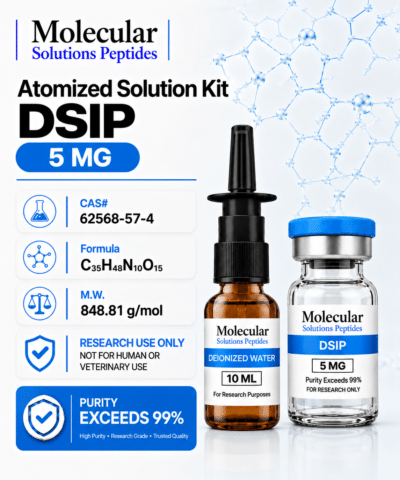
ATOMIZED SOLUTION KIT DSIP (5mg)
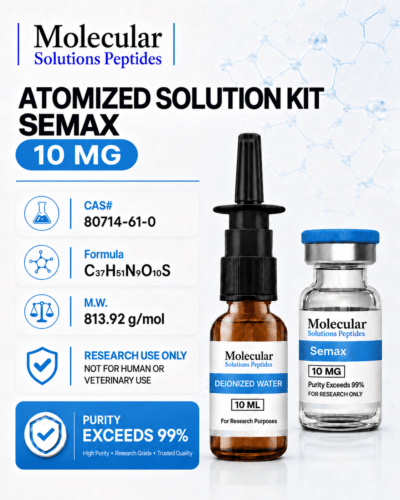
ATOMIZED SOLUTION KIT Semax (10mg)
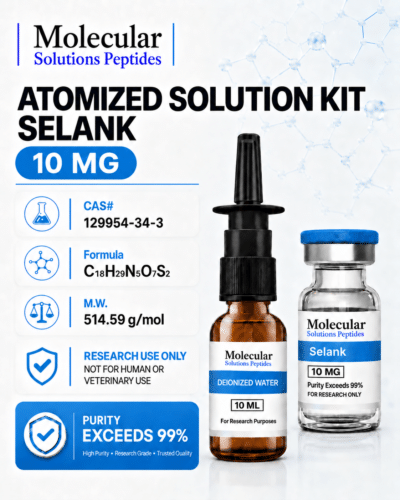
ATOMIZED SOLUTION KIT Selank 10mg (11mg)
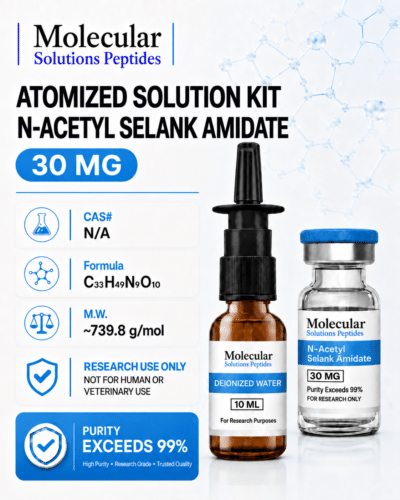
ATOMIZED SOLUTION KIT Selank Amidate 30mg N-Acetyl
Check out our Blog



What Is DSIP Peptide?
Delta sleep-inducing peptide, or DSIP peptide, is a nonapeptide with the sequence Trp-Ala-Gly-Gly-Asp-Ala-Ser-Gly-Glu. Its name reflects its origin in the peptide research literature, where it was first described several decades ago and has since remained a compound of interest for its distinct, well-defined structure.
For anyone exploring this compound in a research context, the short answer is that it belongs to a class of neuropeptides frequently discussed alongside other short, structurally distinct sequences in comparative peptide research. It is not classified as a hormone, a distinction that matters when researchers are working to accurately classify it relative to other regulatory peptides in their sourcing documentation.
At Molecular Solutions Peptides, we handle DSIP as we do every compound in our catalog, with attention to synthesis accuracy and batch consistency. Every unit is intended strictly for laboratory and research use, never for human consumption or application outside that scope.
All products listed on Molecular Solutions Peptides are sold exclusively for research and laboratory use. Products are not intended for human consumption or for use as cosmetics, food additives, chemicals, drugs, or any application outside stated research use.
Inside DSIP Peptide Research
Understanding a compound fully means looking beyond its basic definition and into its structural and classification profile. Researchers examining this peptide tend to focus on distinct angles, from its synthesis characteristics to its place within the broader peptide literature.
Breaking down its research profile into focused areas helps clarify what is actually being studied and why:
Structural And Synthesis Considerations
Every laboratory application involving this compound depends entirely on the exact precision of its amino acid sequence: Trp-Ala-Gly-Gly-Asp-Ala-Ser-Gly-Glu. During solid-phase peptide synthesis (SPPS), even minor deviations in coupling efficiency can compromise the molecular integrity of the batch. Because small variations in synthesis alter a peptide’s chemical consistency, we treat synthesis accuracy as a strict, non-negotiable metric—utilizing small-batch monitoring to ensure every vial meets its structural benchmark.
A Long-Standing Compound In The Literature
Much of the interest around this peptide stems from its long history in the peptide research literature, where it has been referenced and discussed across a range of academic sources for several decades. This ongoing presence in the literature helps researchers build a clearer picture of the compound’s structural and classification profile over time.
Getting Grounded In The Basics
Researchers newer to this compound often benefit from stepping back to the fundamentals of peptide classification before going deeper into more specialized areas of study.
Our resource on What Are Research Peptides walks through how compounds are categorized and studied, offering useful groundwork before diving into more specialized areas like DSIP.
All products listed on Molecular Solutions Peptides are sold exclusively for research and laboratory use. Products are not intended for human consumption or for use as cosmetics, food additives, chemicals, drugs, or any application outside stated research use.
How DSIP Peptide Fits Into A Research Toolkit
No compound exists in a vacuum, and this one is often studied within a broader framework of peptide research rather than as a standalone subject. Researchers frequently draw comparisons across compound classes to understand structural similarities and differences. Placing this peptide within that larger context helps explain why it continues to draw interest across multiple areas of peptide chemistry:
Positioning Within Peptide Classifications
Peptides used in laboratory research vary widely in structure and length, and understanding where a compound fits within that landscape matters greatly for accurate classification and sourcing documentation.
Researchers often build comparative frameworks that place newer compounds alongside more established ones to identify overlapping or divergent structural characteristics worth noting in their records.
Comparative Interest With Other Compounds
Some researchers building a broader sourcing protocol look at compounds with differing structural profiles side by side, including n-acetyl selank amidate, given its own distinct place within the wider field of peptide study overall. Semax Peptide is another compound frequently referenced in these comparative discussions due to its structural profile relative to DSIP.
Documenting Comparative Findings
When researchers source and characterize multiple compounds together, consistent documentation becomes essential for tracking structural and analytical differences over time across laboratory records. Maintaining detailed records allows for clearer comparisons and reduces the chance of misattributing results, particularly when working with compounds that share overlapping areas of classification within a single sourcing protocol.
Sourcing DSIP Peptide For Laboratory Use
Access to a reliable compound is only as good as the source behind it. Laboratory research demands absolute consistency from batch to batch, alongside comprehensive documentation that verifies material identity.
Choosing where to source this nonapeptide matters just as much as understanding the compound itself, since even a thoroughly documented research material loses its experimental utility if the chain of supply cannot be fully trusted.
Purity Standards And Testing
Quality control should never be an afterthought when selecting a supplier for laboratory materials. At Molecular Solutions Peptides, every batch is held to a strong purity target, verified through High-Performance Liquid Chromatography and Mass Spectrometry testing, giving researchers a dependable baseline for their sourcing decisions and helping maintain consistency across every order placed.
Handling And Packaging Practices
Proper packaging protects a compound’s integrity from the moment it leaves production to when it reaches a lab bench. Materials are supplied in capsules, packaged with care to preserve stability during shipping, and handled according to standards that reflect the seriousness expected of laboratory-grade research work carried out by researchers in the field.
Exploring Related Research Areas
Researchers working across peptide chemistry and comparative sourcing often find themselves evaluating compounds with very different structural profiles. Our piece on Tesofensine Peptide is one example of how varied this field has become, with separate compound classes sourced for entirely different laboratory applications within the same peptide research ecosystem.
Final Thoughts
DSIP Peptide remains a compound of ongoing interest for laboratories working with short, well-defined peptide sequences. Selecting a verified supplier ensures your sourcing is built on structural accuracy and reproducible documentation.
All compounds from Molecular Solutions Peptides are intended exclusively for laboratory research and are not for human use.
Disclaimer:All products sold by Molecular Solutions Peptides are intended strictly for laboratory research use only (RUO), not for human consumption, diagnostic use, or therapeutic use. These compounds have not been evaluated or approved by the FDA for any purpose. See our RUO Policy for full terms.
Frequently Asked Questions
Is DSIP peptide the same as a hormone?
No, DSIP peptide is classified as a neuropeptide rather than a hormone. This distinction is important for researchers trying to classify it accurately within their sourcing and documentation records.
Where does the DSIP peptide name come from?
The name reflects its early description in the peptide research literature several decades ago. Its naming has remained consistent even as newer analytical methods have refined how the compound is characterized today.
Can DSIP peptide be purchased for personal use?
No, DSIP peptide is sold strictly for laboratory and research purposes. It is not intended for personal, cosmetic, or human use of any kind.
How is DSIP peptide typically supplied?
It is typically supplied in capsule form for ease of laboratory handling and storage. This format helps maintain consistency across batches during shipping and use.
What testing methods confirm the purity of DSIP peptide?
Purity is commonly confirmed through High-Performance Liquid Chromatography and Mass Spectrometry testing. These methods help verify that a batch meets the intended research-grade standard.
Is DSIP peptide still referenced in current peptide research?
Yes, it remains a recognized reference compound within the broader peptide research literature. Researchers continue to cite and compare it structurally against other short-chain peptides.
Does DSIP peptide have a standardized research protocol?
There is no single standardized protocol, as sourcing and characterization approaches vary depending on each laboratory's specific objectives and documentation needs.